

Articles in press have been peer-reviewed and accepted, which are not yet assigned to volumes /issues, but are citable by Digital Object Identifier (DOI).
Display Method:
, Available online ,
doi: 10.1016/j.gee.2026.06.015
Abstract:
, Available online ,
doi: 10.1016/j.gee.2026.06.018
Abstract:
, Available online ,
doi: 10.1016/j.gee.2026.06.006
Abstract:
Cover info & Content

2026, 11(3): 591-602.
doi: 10.1016/j.gee.2025.12.015
Abstract:
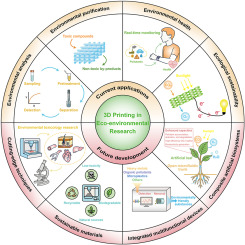
Three-dimensional (3D) printing technology is emerging as a transformative tool in eco-environmental research. It innovates environmental analysis technologies, augments environmental purification, alleviates environmental health risks, and fosters ecological sustainability. Nevertheless, most current applications of 3D printing in the eco-environmental domain remain largely confined to laboratory testing stages, with limited translation to large-scale and real-world deployment. In this viewpoint, we review recent progress and critical challenges within this field, while providing strategic perspectives for its future trajectory. We highlight the imperative to integrate cutting-edge 3D printing techniques into eco-environmental research, advance sustainable printing materials, and develop integrated multifunctional devices for environmental monitoring and remediation. Furthermore, we introduce a pioneering conceptual framework: self-sustaining composite artificial biosystems. Here we envision it as a bionic tree, a 3D-printed biohybrid construct that integrates an open microfluidic scaffold with engineered living materials to autonomously maintain biological activity through self-driven internal mass transport. While emulating key morphological and physiological features of natural plants, the bionic tree transcends its natural analogue by enabling synthetic biology-guided environmental remediation, CO2 sequestration, and energy production. We provide an in-depth analysis of the rationale behind this concept, assess its technical feasibility, and present a developmental roadmap for this emerging research direction. Our insights are poised to amplify the contribution of 3D printing to the eco-environmental sector, thereby facilitating environmental pollution control and sustainable development.
Three-dimensional (3D) printing technology is emerging as a transformative tool in eco-environmental research. It innovates environmental analysis technologies, augments environmental purification, alleviates environmental health risks, and fosters ecological sustainability. Nevertheless, most current applications of 3D printing in the eco-environmental domain remain largely confined to laboratory testing stages, with limited translation to large-scale and real-world deployment. In this viewpoint, we review recent progress and critical challenges within this field, while providing strategic perspectives for its future trajectory. We highlight the imperative to integrate cutting-edge 3D printing techniques into eco-environmental research, advance sustainable printing materials, and develop integrated multifunctional devices for environmental monitoring and remediation. Furthermore, we introduce a pioneering conceptual framework: self-sustaining composite artificial biosystems. Here we envision it as a bionic tree, a 3D-printed biohybrid construct that integrates an open microfluidic scaffold with engineered living materials to autonomously maintain biological activity through self-driven internal mass transport. While emulating key morphological and physiological features of natural plants, the bionic tree transcends its natural analogue by enabling synthetic biology-guided environmental remediation, CO2 sequestration, and energy production. We provide an in-depth analysis of the rationale behind this concept, assess its technical feasibility, and present a developmental roadmap for this emerging research direction. Our insights are poised to amplify the contribution of 3D printing to the eco-environmental sector, thereby facilitating environmental pollution control and sustainable development.

2026, 11(3): 603-629.
doi: 10.1016/j.gee.2025.12.018
Abstract:
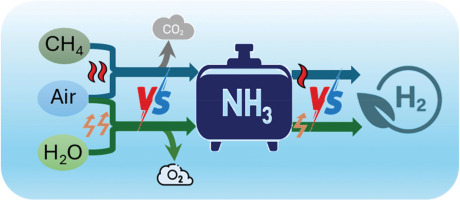
Ammonia (NH3) is a key chemical for agriculture, energy storage, and industrial processes. Its synthesis and cracking (decomposition) are pivotal for a sustainable energy future, particularly in the context of green energy transitions. Two major approaches for these processes are thermocatalysis and electrocatalysis, each with unique mechanisms, challenges, and advantages, as discussed in this review. Thermocatalysis is more mature but energy-intensive, while electrocatalysis promises lower energy consumption and compatibility with renewable energy sources. Electrochemical approach has the potential to eliminate carbon emissions if coupled with green electricity, whereas thermocatalysis is reliant on fossil fuels unless carbon capture is implemented. Thermocatalytic processes for ammonia are well-established at an industrial scale, whereas electrocatalytic systems require further technological development to match this capacity. In summary, thermocatalysis remains the dominant method for ammonia synthesis and cracking due to its industrial maturity. However, electrocatalysis offers a promising pathway toward sustainable and decentralized solutions, provided ongoing challenges in efficiency, stability, and scalability are addressed. Balancing these technologies will be crucial in transitioning to a low-carbon economy.
Ammonia (NH3) is a key chemical for agriculture, energy storage, and industrial processes. Its synthesis and cracking (decomposition) are pivotal for a sustainable energy future, particularly in the context of green energy transitions. Two major approaches for these processes are thermocatalysis and electrocatalysis, each with unique mechanisms, challenges, and advantages, as discussed in this review. Thermocatalysis is more mature but energy-intensive, while electrocatalysis promises lower energy consumption and compatibility with renewable energy sources. Electrochemical approach has the potential to eliminate carbon emissions if coupled with green electricity, whereas thermocatalysis is reliant on fossil fuels unless carbon capture is implemented. Thermocatalytic processes for ammonia are well-established at an industrial scale, whereas electrocatalytic systems require further technological development to match this capacity. In summary, thermocatalysis remains the dominant method for ammonia synthesis and cracking due to its industrial maturity. However, electrocatalysis offers a promising pathway toward sustainable and decentralized solutions, provided ongoing challenges in efficiency, stability, and scalability are addressed. Balancing these technologies will be crucial in transitioning to a low-carbon economy.

2026, 11(3): 630-698.
doi: 10.1016/j.gee.2026.01.005
Abstract:
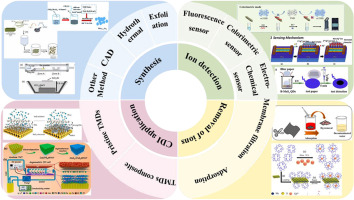
At present, global freshwater resources are severely lacking, and all life activities rely on freshwater resources. Industrial and domestic wastewater contains a large amount of toxic heavy metal ions and other toxic substances, which are not only harmful to human health but also cause significant damage to the environment. Therefore, it is necessary to detect and remove these metal ions. Although many technologies have been studied, there are still many deficiencies. At the same time, due to the vast proportion of the ocean on the earth, people hope that seawater resources can also be utilized by humans, and research on seawater desalination technology is being carried out. Capacitive deionization (CDI) technology has high desalination efficiency and no secondary pollution during the desalination process, and is therefore widely used. The core of these technologies lies in the materials used. Graphene-like materials, with their large specific surface area and numerous surface active sites, have been widely studied, especially transition metal dichalcogenides (TMDs) materials, which have excellent physical and chemical properties. This article mainly introduces the application of TMDs materials in the detection and removal of heavy metal ions in solutions and in CDI desalination, analyzes the advantages and disadvantages of the materials, and discusses the future development direction.
At present, global freshwater resources are severely lacking, and all life activities rely on freshwater resources. Industrial and domestic wastewater contains a large amount of toxic heavy metal ions and other toxic substances, which are not only harmful to human health but also cause significant damage to the environment. Therefore, it is necessary to detect and remove these metal ions. Although many technologies have been studied, there are still many deficiencies. At the same time, due to the vast proportion of the ocean on the earth, people hope that seawater resources can also be utilized by humans, and research on seawater desalination technology is being carried out. Capacitive deionization (CDI) technology has high desalination efficiency and no secondary pollution during the desalination process, and is therefore widely used. The core of these technologies lies in the materials used. Graphene-like materials, with their large specific surface area and numerous surface active sites, have been widely studied, especially transition metal dichalcogenides (TMDs) materials, which have excellent physical and chemical properties. This article mainly introduces the application of TMDs materials in the detection and removal of heavy metal ions in solutions and in CDI desalination, analyzes the advantages and disadvantages of the materials, and discusses the future development direction.

2026, 11(3): 699-723.
doi: 10.1016/j.gee.2025.12.013
Abstract:
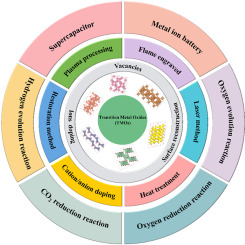
The electrochemical performance of transition metal oxides (TMOs) is significantly influenced by their surfaces and interfaces, which are pivotal in facilitating charge transfer, ion diffusion, and catalytic reactions. However, intrinsic limitations such as poor conductivity, insufficient active sites, and structural instability often hinder their efficiency. Surface/interface modification addresses these challenges by engineering the material at the atomic and nanoscale levels, thereby enhancing its functional performance. The rational design of transition metal oxide (TMO) surfaces and interfaces is pivotal in advancing electrochemical energy storage and conversion technologies, which involves tailoring the surface electronic structure, optimizing the surface topography, enhancing charge transfer rates, and incorporating vacancy defects. Surface and interface modification offers a plethora of active sites, thereby becoming indispensable in enhancing material properties. This review systematically summarizes the latest advancements in the surface/interface modification of transition metal oxides, with a particular focus on the strategies to enhance the electrochemical performance and stability of these materials in energy storage applications. It begins with a thorough exploration of vacancy engineering and delves into the fundamental mechanisms underlying ion doping. Subsequently, various methods for modifying interfaces and surfaces, including thermal treatment, reduction method, cation/anion doping, plasma treatment, combustion treatment, laser ablation, are meticulously discussed. Furthermore, the crucial role of surface/interface modification of transition metal oxides in catalysis, supercapacitors, and secondary batteries is elaborated in detail. Finally, the review addresses the challenges and future prospects associated with modifying the surfaces/interfaces of transition metals.
The electrochemical performance of transition metal oxides (TMOs) is significantly influenced by their surfaces and interfaces, which are pivotal in facilitating charge transfer, ion diffusion, and catalytic reactions. However, intrinsic limitations such as poor conductivity, insufficient active sites, and structural instability often hinder their efficiency. Surface/interface modification addresses these challenges by engineering the material at the atomic and nanoscale levels, thereby enhancing its functional performance. The rational design of transition metal oxide (TMO) surfaces and interfaces is pivotal in advancing electrochemical energy storage and conversion technologies, which involves tailoring the surface electronic structure, optimizing the surface topography, enhancing charge transfer rates, and incorporating vacancy defects. Surface and interface modification offers a plethora of active sites, thereby becoming indispensable in enhancing material properties. This review systematically summarizes the latest advancements in the surface/interface modification of transition metal oxides, with a particular focus on the strategies to enhance the electrochemical performance and stability of these materials in energy storage applications. It begins with a thorough exploration of vacancy engineering and delves into the fundamental mechanisms underlying ion doping. Subsequently, various methods for modifying interfaces and surfaces, including thermal treatment, reduction method, cation/anion doping, plasma treatment, combustion treatment, laser ablation, are meticulously discussed. Furthermore, the crucial role of surface/interface modification of transition metal oxides in catalysis, supercapacitors, and secondary batteries is elaborated in detail. Finally, the review addresses the challenges and future prospects associated with modifying the surfaces/interfaces of transition metals.
2023, 8(1): 10-114.
doi: 10.1016/j.gee.2022.07.003
摘要:
In the search of alternative resources to make commodity chemicals and transportation fuels for a low carbon future, lignocellulosic biomass with over 180-billion-ton annual production rate has been identified as a promising feedstock. This review focuses on the state-of-the-art catalytic transformation of lignocellulosic biomass into value-added chemicals and fuels. Following a brief introduction on the structure, major resources and pretreatment methods of lignocellulosic biomass, the catalytic conversion of three main components, i.e., cellulose, hemicellulose and lignin, into various compounds are comprehensively discussed. Either in separate steps or in one-pot, cellulose and hemicellulose are hydrolyzed into sugars and upgraded into oxygen-containing chemicals such as 5-HMF, furfural, polyols, and organic acids, or even nitrogen-containing chemicals such as amino acids. On the other hand, lignin is first depolymerized into phenols, catechols, guaiacols, aldehydes and ketones, and then further transformed into hydrocarbon fuels, bioplastic precursors and bioactive compounds. The review then introduces the transformations of whole biomass via catalytic gasification, catalytic pyrolysis, as well as emerging strategies. Finally, opportunities, challenges and prospective of woody biomass valorization are highlighted.
In the search of alternative resources to make commodity chemicals and transportation fuels for a low carbon future, lignocellulosic biomass with over 180-billion-ton annual production rate has been identified as a promising feedstock. This review focuses on the state-of-the-art catalytic transformation of lignocellulosic biomass into value-added chemicals and fuels. Following a brief introduction on the structure, major resources and pretreatment methods of lignocellulosic biomass, the catalytic conversion of three main components, i.e., cellulose, hemicellulose and lignin, into various compounds are comprehensively discussed. Either in separate steps or in one-pot, cellulose and hemicellulose are hydrolyzed into sugars and upgraded into oxygen-containing chemicals such as 5-HMF, furfural, polyols, and organic acids, or even nitrogen-containing chemicals such as amino acids. On the other hand, lignin is first depolymerized into phenols, catechols, guaiacols, aldehydes and ketones, and then further transformed into hydrocarbon fuels, bioplastic precursors and bioactive compounds. The review then introduces the transformations of whole biomass via catalytic gasification, catalytic pyrolysis, as well as emerging strategies. Finally, opportunities, challenges and prospective of woody biomass valorization are highlighted.
2020, 5(1): 8-21.
doi: 10.1016/j.gee.2019.03.002
摘要:
This review divides the acidic deep eutectic solvents (ADES) into Brønsted and Lewis DES according to their diversity of acidic character. The hydrogen bond donors and halide salts for formulating an ADES are classified, the synthesis methods are described, and the physicochemical properties including freezing point, acidity, density, viscosity and conductivity are presented. Furthermore, the applications of Brønsted acidic deep eutectic solvents (BADES) and Lewis acidic deep eutectic solvents (LADES) are overviewed, respectively, covering the fields in dissolution, extraction, organic reaction and metal electrodeposition. It is expected that the ADES has great potential to replace the pollutional mineral acid, expensive and unstable solid acid, and costly ionic liquid in many acid-employed chemical processes, thus meeting the demands of green chemistry.
This review divides the acidic deep eutectic solvents (ADES) into Brønsted and Lewis DES according to their diversity of acidic character. The hydrogen bond donors and halide salts for formulating an ADES are classified, the synthesis methods are described, and the physicochemical properties including freezing point, acidity, density, viscosity and conductivity are presented. Furthermore, the applications of Brønsted acidic deep eutectic solvents (BADES) and Lewis acidic deep eutectic solvents (LADES) are overviewed, respectively, covering the fields in dissolution, extraction, organic reaction and metal electrodeposition. It is expected that the ADES has great potential to replace the pollutional mineral acid, expensive and unstable solid acid, and costly ionic liquid in many acid-employed chemical processes, thus meeting the demands of green chemistry.
2019, 4(2): 95-115.
doi: 10.1016/j.gee.2019.01.012
摘要:
Biomass is renewable, abundant, cheap, biocompatible, and biodegradable materials and has been used to produce chemicals, materials, energy, and fuels. However, most of the biomass, especially most of the biomass polymers are not soluble in common solvents, which hinders their pretreatment and conversion. Deep eutectic solvents (DESs) are environmental-friendly, cheap, and highly tunable, with high solubility, which renders them potential applications in biomass pretreatment and conversion. They could be used as solvents or catalysts and so on. This paper intends to review the application of DESs for the pretreatment of biomass and conversion of biomass to value-added products. We focus on the following topics related to biomass and DESs: (1) DESs for the pretreatment of biomass; (2) DESs for the dissolution and separation of biomass or extraction of chemicals from biomass; (3) DESs for biomass conversion; (4) Drawbacks, and recyclability of DESs for pretreatment and conversion of biomass.
Biomass is renewable, abundant, cheap, biocompatible, and biodegradable materials and has been used to produce chemicals, materials, energy, and fuels. However, most of the biomass, especially most of the biomass polymers are not soluble in common solvents, which hinders their pretreatment and conversion. Deep eutectic solvents (DESs) are environmental-friendly, cheap, and highly tunable, with high solubility, which renders them potential applications in biomass pretreatment and conversion. They could be used as solvents or catalysts and so on. This paper intends to review the application of DESs for the pretreatment of biomass and conversion of biomass to value-added products. We focus on the following topics related to biomass and DESs: (1) DESs for the pretreatment of biomass; (2) DESs for the dissolution and separation of biomass or extraction of chemicals from biomass; (3) DESs for biomass conversion; (4) Drawbacks, and recyclability of DESs for pretreatment and conversion of biomass.
2017, 2(3): 246-277.
doi: 10.1016/j.gee.2017.06.006
摘要:
The aluminum–air battery is considered to be an attractive candidate as a power source for electric vehicles (EVs) because of its high theoretical energy density (8100 Wh kg−1), which is significantly greater than that of the state-of-the-art lithium-ion batteries (LIBs). However, some technical and scientific problems preventing the large-scale development of Al–air batteries have not yet to be resolved. In this review, we present the fundamentals, challenges and the recent advances in Al–air battery technology from aluminum anode, air cathode and electrocatalysts to electrolytes and inhibitors. Firstly, the alloying of aluminum with transition metal elements is reviewed and shown to reduce the self-corrosion of Al and improve battery performance. Additionally for the cathode, extensive studies of electrocatalytic materials for oxygen reduction/evolution including Pt and Pt alloys, nonprecious metal catalysts, and carbonaceous materials at the air cathode are highlighted. Moreover, for the electrolyte, the application of aqueous and nonaqueous electrolytes in Al–air batteries are discussed. Meanwhile, the addition of inhibitors to the electrolyte to enhance electrochemical performance is also explored. Finally, the challenges and future research directions are proposed for the further development of Al–air batteries.
The aluminum–air battery is considered to be an attractive candidate as a power source for electric vehicles (EVs) because of its high theoretical energy density (8100 Wh kg−1), which is significantly greater than that of the state-of-the-art lithium-ion batteries (LIBs). However, some technical and scientific problems preventing the large-scale development of Al–air batteries have not yet to be resolved. In this review, we present the fundamentals, challenges and the recent advances in Al–air battery technology from aluminum anode, air cathode and electrocatalysts to electrolytes and inhibitors. Firstly, the alloying of aluminum with transition metal elements is reviewed and shown to reduce the self-corrosion of Al and improve battery performance. Additionally for the cathode, extensive studies of electrocatalytic materials for oxygen reduction/evolution including Pt and Pt alloys, nonprecious metal catalysts, and carbonaceous materials at the air cathode are highlighted. Moreover, for the electrolyte, the application of aqueous and nonaqueous electrolytes in Al–air batteries are discussed. Meanwhile, the addition of inhibitors to the electrolyte to enhance electrochemical performance is also explored. Finally, the challenges and future research directions are proposed for the further development of Al–air batteries.
2017, 2(3): 218-245.
doi: 10.1016/j.gee.2017.05.003
摘要:
Metal organic frameworks (MOFs) represent a class of porous material which is formed by strong bonds between metal ions and organic linkers. By careful selection of constituents, MOFs can exhibit very high surface area, large pore volume, and excellent chemical stability. Research on synthesis, structures and properties of various MOFs has shown that they are promising materials for many applications, such as energy storage, gas storage, heterogeneous catalysis and sensing. Apart from direct use, MOFs have also been used as support substrates for nanomaterials or as sacrificial templates/precursors for preparation of various functional nanostructures. In this review, we aim to present the most recent development of MOFs as precursors for the preparation of various nanostructures and their potential applications in energy-related devices and processes. Specifically, this present survey intends to push the boundaries and covers the literatures from the year 2013 to early 2017, on supercapacitors, lithium ion batteries, electrocatalysts, photocatalyst, gas sensing, water treatment, solar cells, and carbon dioxide capture. Finally, an outlook in terms of future challenges and potential prospects towards industrial applications are also discussed.
Metal organic frameworks (MOFs) represent a class of porous material which is formed by strong bonds between metal ions and organic linkers. By careful selection of constituents, MOFs can exhibit very high surface area, large pore volume, and excellent chemical stability. Research on synthesis, structures and properties of various MOFs has shown that they are promising materials for many applications, such as energy storage, gas storage, heterogeneous catalysis and sensing. Apart from direct use, MOFs have also been used as support substrates for nanomaterials or as sacrificial templates/precursors for preparation of various functional nanostructures. In this review, we aim to present the most recent development of MOFs as precursors for the preparation of various nanostructures and their potential applications in energy-related devices and processes. Specifically, this present survey intends to push the boundaries and covers the literatures from the year 2013 to early 2017, on supercapacitors, lithium ion batteries, electrocatalysts, photocatalyst, gas sensing, water treatment, solar cells, and carbon dioxide capture. Finally, an outlook in terms of future challenges and potential prospects towards industrial applications are also discussed.
2018, 3(1): 20-41.
doi: 10.1016/j.gee.2017.10.001
摘要:
Over the past decades, a series of aqueous rechargeable batteries (ARBs) were explored, investigated and demonstrated. Among them, aqueous rechargeable alkali-metal ion (Li+, Na+, K+) batteries, aqueous rechargeable-metal ion (Zn2+, Mg2+, Ca2+, Al3+) batteries and aqueous rechargeable hybrid batteries are standing out due to peculiar properties. In this review, we focus on the fundamental basics of these batteries, and discuss the scientific and/or technological achievements and challenges. By critically reviewing state-of-the-art technologies and the most promising results so far, we aim to analyze the benefits of ARBs and the critical issues to be addressed, and to promote better development of ARBs.
Over the past decades, a series of aqueous rechargeable batteries (ARBs) were explored, investigated and demonstrated. Among them, aqueous rechargeable alkali-metal ion (Li+, Na+, K+) batteries, aqueous rechargeable-metal ion (Zn2+, Mg2+, Ca2+, Al3+) batteries and aqueous rechargeable hybrid batteries are standing out due to peculiar properties. In this review, we focus on the fundamental basics of these batteries, and discuss the scientific and/or technological achievements and challenges. By critically reviewing state-of-the-art technologies and the most promising results so far, we aim to analyze the benefits of ARBs and the critical issues to be addressed, and to promote better development of ARBs.
2022, 7(1): 3-15.
doi: 10.1016/j.gee.2020.12.023
摘要:
In recent years, an increasing amount of interest has been dedicated to the synthesis and application of ZIF-67-based materials due to their exceptionally high surface area, tunable porosity, and excellent thermal and chemical stabilities. This review summarizes the latest strategies of synthesizing ZIF-67-based materials by exploring the prominent examples. Then, the recent progress in the applications of ZIF-67-based materials in heterogeneous catalysis, including catalysis of the redox reactions, addition reactions, esterification reactions, Knoevenagel condensations, and hydrogenation-dehydrogenation reactions, has been elaborately discussed. Finally, we end this work by shedding some light on the large-scale industrial production of ZIF-67-based materials and their applications in the future.
In recent years, an increasing amount of interest has been dedicated to the synthesis and application of ZIF-67-based materials due to their exceptionally high surface area, tunable porosity, and excellent thermal and chemical stabilities. This review summarizes the latest strategies of synthesizing ZIF-67-based materials by exploring the prominent examples. Then, the recent progress in the applications of ZIF-67-based materials in heterogeneous catalysis, including catalysis of the redox reactions, addition reactions, esterification reactions, Knoevenagel condensations, and hydrogenation-dehydrogenation reactions, has been elaborately discussed. Finally, we end this work by shedding some light on the large-scale industrial production of ZIF-67-based materials and their applications in the future.
2020, 5(1): 37-49.
doi: 10.1016/j.gee.2019.09.003
摘要:
The most abundant natural biopolymer on earth, cellulose fiber, may offer a highly efficient, low-cost, and chemical-free option for wastewater treatment. Cellulose is widely distributed in plants and several marine animals. It is a carbohydrate polymer consisting of β-1,4-linked anhydro-D-glucose units with three hydroxyl groups per anhydroglucose unit (AGU). Cellulose-based materials have been used in food, industrial, pharmaceutical, paper, textile production, and in wastewater treatment applications due to their low cost, renewability, biodegradability, and non-toxicity. For water treatment in the oil and gas industry, cellulose-based materials can be used as adsorbents, flocculants, and oil/water separation membranes. In this review, the uses of cellulose-based materials for wastewater treatment in the oil & gas industry are summarized, and recent research progress in the following aspects are highlighted: crude oil spill cleaning, flocculation of solid suspended matter in drilling or oil recovery in the upstream oil industry, adsorption of heavy metal or chemicals, and separation of oil/water by cellulosic membrane in the downstream water treatment.
The most abundant natural biopolymer on earth, cellulose fiber, may offer a highly efficient, low-cost, and chemical-free option for wastewater treatment. Cellulose is widely distributed in plants and several marine animals. It is a carbohydrate polymer consisting of β-1,4-linked anhydro-D-glucose units with three hydroxyl groups per anhydroglucose unit (AGU). Cellulose-based materials have been used in food, industrial, pharmaceutical, paper, textile production, and in wastewater treatment applications due to their low cost, renewability, biodegradability, and non-toxicity. For water treatment in the oil and gas industry, cellulose-based materials can be used as adsorbents, flocculants, and oil/water separation membranes. In this review, the uses of cellulose-based materials for wastewater treatment in the oil & gas industry are summarized, and recent research progress in the following aspects are highlighted: crude oil spill cleaning, flocculation of solid suspended matter in drilling or oil recovery in the upstream oil industry, adsorption of heavy metal or chemicals, and separation of oil/water by cellulosic membrane in the downstream water treatment.
2023, 8(4): 972-988.
doi: 10.1016/j.gee.2022.02.002
摘要:
Developing multifunctional energy storage systems with high specific energy, high specific power and long cycling life has been the one of the most important research directions. Compared to batteries and traditional capacitors, supercapacitors possess more balanced performance with both high specific power and long cycle-life. Nevertheless, regular supercapacitors can only achieve energy storage without harvesting energy and the energy density is still not very high compared to batteries. Therefore, combining high specific energy and high specific power, long cycle-life and even fast self-charging into one cell has been a promising direction for future energy storage devices. The multifunctional hybrid supercapacitors like asymmetric supercapacitors, batteries/supercapacitors hybrid devices and self-charging hybrid supercapacitors have been widely studied recently. Carbon based electrodes are common materials used in all kinds of energy storage devices due to their fabulous electrical and mechanical properties. In this survey, the research progress of all kinds of hybrid supercapacitors using multiple effects and their working mechanisms are briefly reviewed. And their advantages and disadvantages are discussed. The hybrid supercapacitors have great application potential for portable electronics, wearable devices and implantable devices in the future.
Developing multifunctional energy storage systems with high specific energy, high specific power and long cycling life has been the one of the most important research directions. Compared to batteries and traditional capacitors, supercapacitors possess more balanced performance with both high specific power and long cycle-life. Nevertheless, regular supercapacitors can only achieve energy storage without harvesting energy and the energy density is still not very high compared to batteries. Therefore, combining high specific energy and high specific power, long cycle-life and even fast self-charging into one cell has been a promising direction for future energy storage devices. The multifunctional hybrid supercapacitors like asymmetric supercapacitors, batteries/supercapacitors hybrid devices and self-charging hybrid supercapacitors have been widely studied recently. Carbon based electrodes are common materials used in all kinds of energy storage devices due to their fabulous electrical and mechanical properties. In this survey, the research progress of all kinds of hybrid supercapacitors using multiple effects and their working mechanisms are briefly reviewed. And their advantages and disadvantages are discussed. The hybrid supercapacitors have great application potential for portable electronics, wearable devices and implantable devices in the future.
2022, 7(4): 578-605.
doi: 10.1016/j.gee.2021.04.006
摘要:
As an aromatic polymer in nature, lignin has recently attracted gross attention because of its advantages of high carbon content, low cost and bio-renewability. However, most lignin is directly burnt for power generation to satisfy the energy demand of the pulp mills. As a result, only a handful of isolated lignin is used as a raw material. Thus, increasing value addition on lignin to expand its scope of applications is currently a challenge demanding immediate attention. Many efforts have been made in the valorization of lignin, including the preparation of precursors for carbon fibers. However, its complex structure and diversity significantly restrict the spinnability of lignin. In this review, we provide elaborate knowledge on the preparation of lignin-based carbon fibers ranging from the relationships among chemical structures, formation conditions and properties of fibers, to their potential applications. Specifically, control procedures for different spinning methods of lignin, including melt spinning, solution spinning and electrospinning, together with stabilization and carbonization are deeply discussed to provide an overall understanding towards the formation of lignin-based carbon fibers. We also offer perspectives on the challenges and new directions for future development of lignin-based carbon fibers.
As an aromatic polymer in nature, lignin has recently attracted gross attention because of its advantages of high carbon content, low cost and bio-renewability. However, most lignin is directly burnt for power generation to satisfy the energy demand of the pulp mills. As a result, only a handful of isolated lignin is used as a raw material. Thus, increasing value addition on lignin to expand its scope of applications is currently a challenge demanding immediate attention. Many efforts have been made in the valorization of lignin, including the preparation of precursors for carbon fibers. However, its complex structure and diversity significantly restrict the spinnability of lignin. In this review, we provide elaborate knowledge on the preparation of lignin-based carbon fibers ranging from the relationships among chemical structures, formation conditions and properties of fibers, to their potential applications. Specifically, control procedures for different spinning methods of lignin, including melt spinning, solution spinning and electrospinning, together with stabilization and carbonization are deeply discussed to provide an overall understanding towards the formation of lignin-based carbon fibers. We also offer perspectives on the challenges and new directions for future development of lignin-based carbon fibers.
2024, 9(9): 1366-1383.
doi: 10.1016/j.gee.2023.10.002
Abstract:
2017, 2(3): 246-277.
doi: 10.1016/j.gee.2017.06.006
Abstract:
2024, 9(9): 1459-1465.
doi: 10.1016/j.gee.2023.09.002
Abstract:
2023, 8(2): 351-353.
doi: 10.1016/j.gee.2022.06.002
Abstract:
2023, 8(1): 10-114.
doi: 10.1016/j.gee.2022.07.003
Abstract:
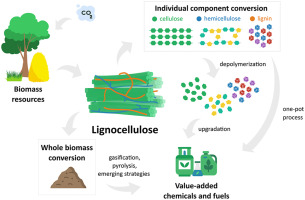
In the search of alternative resources to make commodity chemicals and transportation fuels for a low carbon future, lignocellulosic biomass with over 180-billion-ton annual production rate has been identified as a promising feedstock. This review focuses on the state-of-the-art catalytic transformation of lignocellulosic biomass into value-added chemicals and fuels. Following a brief introduction on the structure, major resources and pretreatment methods of lignocellulosic biomass, the catalytic conversion of three main components, i.e., cellulose, hemicellulose and lignin, into various compounds are comprehensively discussed. Either in separate steps or in one-pot, cellulose and hemicellulose are hydrolyzed into sugars and upgraded into oxygen-containing chemicals such as 5-HMF, furfural, polyols, and organic acids, or even nitrogen-containing chemicals such as amino acids. On the other hand, lignin is first depolymerized into phenols, catechols, guaiacols, aldehydes and ketones, and then further transformed into hydrocarbon fuels, bioplastic precursors and bioactive compounds. The review then introduces the transformations of whole biomass via catalytic gasification, catalytic pyrolysis, as well as emerging strategies. Finally, opportunities, challenges and prospective of woody biomass valorization are highlighted.
In the search of alternative resources to make commodity chemicals and transportation fuels for a low carbon future, lignocellulosic biomass with over 180-billion-ton annual production rate has been identified as a promising feedstock. This review focuses on the state-of-the-art catalytic transformation of lignocellulosic biomass into value-added chemicals and fuels. Following a brief introduction on the structure, major resources and pretreatment methods of lignocellulosic biomass, the catalytic conversion of three main components, i.e., cellulose, hemicellulose and lignin, into various compounds are comprehensively discussed. Either in separate steps or in one-pot, cellulose and hemicellulose are hydrolyzed into sugars and upgraded into oxygen-containing chemicals such as 5-HMF, furfural, polyols, and organic acids, or even nitrogen-containing chemicals such as amino acids. On the other hand, lignin is first depolymerized into phenols, catechols, guaiacols, aldehydes and ketones, and then further transformed into hydrocarbon fuels, bioplastic precursors and bioactive compounds. The review then introduces the transformations of whole biomass via catalytic gasification, catalytic pyrolysis, as well as emerging strategies. Finally, opportunities, challenges and prospective of woody biomass valorization are highlighted.
2020, 5(1): 8-21.
doi: 10.1016/j.gee.2019.03.002
Abstract:
This review divides the acidic deep eutectic solvents (ADES) into Brønsted and Lewis DES according to their diversity of acidic character. The hydrogen bond donors and halide salts for formulating an ADES are classified, the synthesis methods are described, and the physicochemical properties including freezing point, acidity, density, viscosity and conductivity are presented. Furthermore, the applications of Brønsted acidic deep eutectic solvents (BADES) and Lewis acidic deep eutectic solvents (LADES) are overviewed, respectively, covering the fields in dissolution, extraction, organic reaction and metal electrodeposition. It is expected that the ADES has great potential to replace the pollutional mineral acid, expensive and unstable solid acid, and costly ionic liquid in many acid-employed chemical processes, thus meeting the demands of green chemistry.
This review divides the acidic deep eutectic solvents (ADES) into Brønsted and Lewis DES according to their diversity of acidic character. The hydrogen bond donors and halide salts for formulating an ADES are classified, the synthesis methods are described, and the physicochemical properties including freezing point, acidity, density, viscosity and conductivity are presented. Furthermore, the applications of Brønsted acidic deep eutectic solvents (BADES) and Lewis acidic deep eutectic solvents (LADES) are overviewed, respectively, covering the fields in dissolution, extraction, organic reaction and metal electrodeposition. It is expected that the ADES has great potential to replace the pollutional mineral acid, expensive and unstable solid acid, and costly ionic liquid in many acid-employed chemical processes, thus meeting the demands of green chemistry.
2019, 4(2): 95-115.
doi: 10.1016/j.gee.2019.01.012
Abstract:
Biomass is renewable, abundant, cheap, biocompatible, and biodegradable materials and has been used to produce chemicals, materials, energy, and fuels. However, most of the biomass, especially most of the biomass polymers are not soluble in common solvents, which hinders their pretreatment and conversion. Deep eutectic solvents (DESs) are environmental-friendly, cheap, and highly tunable, with high solubility, which renders them potential applications in biomass pretreatment and conversion. They could be used as solvents or catalysts and so on. This paper intends to review the application of DESs for the pretreatment of biomass and conversion of biomass to value-added products. We focus on the following topics related to biomass and DESs: (1) DESs for the pretreatment of biomass; (2) DESs for the dissolution and separation of biomass or extraction of chemicals from biomass; (3) DESs for biomass conversion; (4) Drawbacks, and recyclability of DESs for pretreatment and conversion of biomass.
Biomass is renewable, abundant, cheap, biocompatible, and biodegradable materials and has been used to produce chemicals, materials, energy, and fuels. However, most of the biomass, especially most of the biomass polymers are not soluble in common solvents, which hinders their pretreatment and conversion. Deep eutectic solvents (DESs) are environmental-friendly, cheap, and highly tunable, with high solubility, which renders them potential applications in biomass pretreatment and conversion. They could be used as solvents or catalysts and so on. This paper intends to review the application of DESs for the pretreatment of biomass and conversion of biomass to value-added products. We focus on the following topics related to biomass and DESs: (1) DESs for the pretreatment of biomass; (2) DESs for the dissolution and separation of biomass or extraction of chemicals from biomass; (3) DESs for biomass conversion; (4) Drawbacks, and recyclability of DESs for pretreatment and conversion of biomass.
2017, 2(3): 246-277.
doi: 10.1016/j.gee.2017.06.006
Abstract:
The aluminum–air battery is considered to be an attractive candidate as a power source for electric vehicles (EVs) because of its high theoretical energy density (8100 Wh kg−1), which is significantly greater than that of the state-of-the-art lithium-ion batteries (LIBs). However, some technical and scientific problems preventing the large-scale development of Al–air batteries have not yet to be resolved. In this review, we present the fundamentals, challenges and the recent advances in Al–air battery technology from aluminum anode, air cathode and electrocatalysts to electrolytes and inhibitors. Firstly, the alloying of aluminum with transition metal elements is reviewed and shown to reduce the self-corrosion of Al and improve battery performance. Additionally for the cathode, extensive studies of electrocatalytic materials for oxygen reduction/evolution including Pt and Pt alloys, nonprecious metal catalysts, and carbonaceous materials at the air cathode are highlighted. Moreover, for the electrolyte, the application of aqueous and nonaqueous electrolytes in Al–air batteries are discussed. Meanwhile, the addition of inhibitors to the electrolyte to enhance electrochemical performance is also explored. Finally, the challenges and future research directions are proposed for the further development of Al–air batteries.
The aluminum–air battery is considered to be an attractive candidate as a power source for electric vehicles (EVs) because of its high theoretical energy density (8100 Wh kg−1), which is significantly greater than that of the state-of-the-art lithium-ion batteries (LIBs). However, some technical and scientific problems preventing the large-scale development of Al–air batteries have not yet to be resolved. In this review, we present the fundamentals, challenges and the recent advances in Al–air battery technology from aluminum anode, air cathode and electrocatalysts to electrolytes and inhibitors. Firstly, the alloying of aluminum with transition metal elements is reviewed and shown to reduce the self-corrosion of Al and improve battery performance. Additionally for the cathode, extensive studies of electrocatalytic materials for oxygen reduction/evolution including Pt and Pt alloys, nonprecious metal catalysts, and carbonaceous materials at the air cathode are highlighted. Moreover, for the electrolyte, the application of aqueous and nonaqueous electrolytes in Al–air batteries are discussed. Meanwhile, the addition of inhibitors to the electrolyte to enhance electrochemical performance is also explored. Finally, the challenges and future research directions are proposed for the further development of Al–air batteries.
2017, 2(3): 218-245.
doi: 10.1016/j.gee.2017.05.003
Abstract:
Metal organic frameworks (MOFs) represent a class of porous material which is formed by strong bonds between metal ions and organic linkers. By careful selection of constituents, MOFs can exhibit very high surface area, large pore volume, and excellent chemical stability. Research on synthesis, structures and properties of various MOFs has shown that they are promising materials for many applications, such as energy storage, gas storage, heterogeneous catalysis and sensing. Apart from direct use, MOFs have also been used as support substrates for nanomaterials or as sacrificial templates/precursors for preparation of various functional nanostructures. In this review, we aim to present the most recent development of MOFs as precursors for the preparation of various nanostructures and their potential applications in energy-related devices and processes. Specifically, this present survey intends to push the boundaries and covers the literatures from the year 2013 to early 2017, on supercapacitors, lithium ion batteries, electrocatalysts, photocatalyst, gas sensing, water treatment, solar cells, and carbon dioxide capture. Finally, an outlook in terms of future challenges and potential prospects towards industrial applications are also discussed.
Metal organic frameworks (MOFs) represent a class of porous material which is formed by strong bonds between metal ions and organic linkers. By careful selection of constituents, MOFs can exhibit very high surface area, large pore volume, and excellent chemical stability. Research on synthesis, structures and properties of various MOFs has shown that they are promising materials for many applications, such as energy storage, gas storage, heterogeneous catalysis and sensing. Apart from direct use, MOFs have also been used as support substrates for nanomaterials or as sacrificial templates/precursors for preparation of various functional nanostructures. In this review, we aim to present the most recent development of MOFs as precursors for the preparation of various nanostructures and their potential applications in energy-related devices and processes. Specifically, this present survey intends to push the boundaries and covers the literatures from the year 2013 to early 2017, on supercapacitors, lithium ion batteries, electrocatalysts, photocatalyst, gas sensing, water treatment, solar cells, and carbon dioxide capture. Finally, an outlook in terms of future challenges and potential prospects towards industrial applications are also discussed.
2018, 3(1): 20-41.
doi: 10.1016/j.gee.2017.10.001
Abstract:
Over the past decades, a series of aqueous rechargeable batteries (ARBs) were explored, investigated and demonstrated. Among them, aqueous rechargeable alkali-metal ion (Li+, Na+, K+) batteries, aqueous rechargeable-metal ion (Zn2+, Mg2+, Ca2+, Al3+) batteries and aqueous rechargeable hybrid batteries are standing out due to peculiar properties. In this review, we focus on the fundamental basics of these batteries, and discuss the scientific and/or technological achievements and challenges. By critically reviewing state-of-the-art technologies and the most promising results so far, we aim to analyze the benefits of ARBs and the critical issues to be addressed, and to promote better development of ARBs.
Over the past decades, a series of aqueous rechargeable batteries (ARBs) were explored, investigated and demonstrated. Among them, aqueous rechargeable alkali-metal ion (Li+, Na+, K+) batteries, aqueous rechargeable-metal ion (Zn2+, Mg2+, Ca2+, Al3+) batteries and aqueous rechargeable hybrid batteries are standing out due to peculiar properties. In this review, we focus on the fundamental basics of these batteries, and discuss the scientific and/or technological achievements and challenges. By critically reviewing state-of-the-art technologies and the most promising results so far, we aim to analyze the benefits of ARBs and the critical issues to be addressed, and to promote better development of ARBs.
2022, 7(1): 3-15.
doi: 10.1016/j.gee.2020.12.023
Abstract:
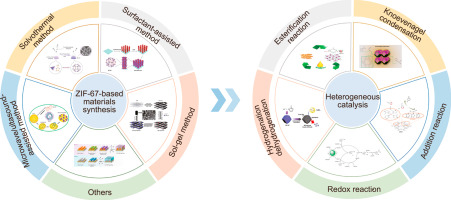
In recent years, an increasing amount of interest has been dedicated to the synthesis and application of ZIF-67-based materials due to their exceptionally high surface area, tunable porosity, and excellent thermal and chemical stabilities. This review summarizes the latest strategies of synthesizing ZIF-67-based materials by exploring the prominent examples. Then, the recent progress in the applications of ZIF-67-based materials in heterogeneous catalysis, including catalysis of the redox reactions, addition reactions, esterification reactions, Knoevenagel condensations, and hydrogenation-dehydrogenation reactions, has been elaborately discussed. Finally, we end this work by shedding some light on the large-scale industrial production of ZIF-67-based materials and their applications in the future.
In recent years, an increasing amount of interest has been dedicated to the synthesis and application of ZIF-67-based materials due to their exceptionally high surface area, tunable porosity, and excellent thermal and chemical stabilities. This review summarizes the latest strategies of synthesizing ZIF-67-based materials by exploring the prominent examples. Then, the recent progress in the applications of ZIF-67-based materials in heterogeneous catalysis, including catalysis of the redox reactions, addition reactions, esterification reactions, Knoevenagel condensations, and hydrogenation-dehydrogenation reactions, has been elaborately discussed. Finally, we end this work by shedding some light on the large-scale industrial production of ZIF-67-based materials and their applications in the future.
2020, 5(1): 37-49.
doi: 10.1016/j.gee.2019.09.003
Abstract:
The most abundant natural biopolymer on earth, cellulose fiber, may offer a highly efficient, low-cost, and chemical-free option for wastewater treatment. Cellulose is widely distributed in plants and several marine animals. It is a carbohydrate polymer consisting of β-1,4-linked anhydro-D-glucose units with three hydroxyl groups per anhydroglucose unit (AGU). Cellulose-based materials have been used in food, industrial, pharmaceutical, paper, textile production, and in wastewater treatment applications due to their low cost, renewability, biodegradability, and non-toxicity. For water treatment in the oil and gas industry, cellulose-based materials can be used as adsorbents, flocculants, and oil/water separation membranes. In this review, the uses of cellulose-based materials for wastewater treatment in the oil & gas industry are summarized, and recent research progress in the following aspects are highlighted: crude oil spill cleaning, flocculation of solid suspended matter in drilling or oil recovery in the upstream oil industry, adsorption of heavy metal or chemicals, and separation of oil/water by cellulosic membrane in the downstream water treatment.
The most abundant natural biopolymer on earth, cellulose fiber, may offer a highly efficient, low-cost, and chemical-free option for wastewater treatment. Cellulose is widely distributed in plants and several marine animals. It is a carbohydrate polymer consisting of β-1,4-linked anhydro-D-glucose units with three hydroxyl groups per anhydroglucose unit (AGU). Cellulose-based materials have been used in food, industrial, pharmaceutical, paper, textile production, and in wastewater treatment applications due to their low cost, renewability, biodegradability, and non-toxicity. For water treatment in the oil and gas industry, cellulose-based materials can be used as adsorbents, flocculants, and oil/water separation membranes. In this review, the uses of cellulose-based materials for wastewater treatment in the oil & gas industry are summarized, and recent research progress in the following aspects are highlighted: crude oil spill cleaning, flocculation of solid suspended matter in drilling or oil recovery in the upstream oil industry, adsorption of heavy metal or chemicals, and separation of oil/water by cellulosic membrane in the downstream water treatment.
2023, 8(4): 972-988.
doi: 10.1016/j.gee.2022.02.002
Abstract:
Developing multifunctional energy storage systems with high specific energy, high specific power and long cycling life has been the one of the most important research directions. Compared to batteries and traditional capacitors, supercapacitors possess more balanced performance with both high specific power and long cycle-life. Nevertheless, regular supercapacitors can only achieve energy storage without harvesting energy and the energy density is still not very high compared to batteries. Therefore, combining high specific energy and high specific power, long cycle-life and even fast self-charging into one cell has been a promising direction for future energy storage devices. The multifunctional hybrid supercapacitors like asymmetric supercapacitors, batteries/supercapacitors hybrid devices and self-charging hybrid supercapacitors have been widely studied recently. Carbon based electrodes are common materials used in all kinds of energy storage devices due to their fabulous electrical and mechanical properties. In this survey, the research progress of all kinds of hybrid supercapacitors using multiple effects and their working mechanisms are briefly reviewed. And their advantages and disadvantages are discussed. The hybrid supercapacitors have great application potential for portable electronics, wearable devices and implantable devices in the future.
Developing multifunctional energy storage systems with high specific energy, high specific power and long cycling life has been the one of the most important research directions. Compared to batteries and traditional capacitors, supercapacitors possess more balanced performance with both high specific power and long cycle-life. Nevertheless, regular supercapacitors can only achieve energy storage without harvesting energy and the energy density is still not very high compared to batteries. Therefore, combining high specific energy and high specific power, long cycle-life and even fast self-charging into one cell has been a promising direction for future energy storage devices. The multifunctional hybrid supercapacitors like asymmetric supercapacitors, batteries/supercapacitors hybrid devices and self-charging hybrid supercapacitors have been widely studied recently. Carbon based electrodes are common materials used in all kinds of energy storage devices due to their fabulous electrical and mechanical properties. In this survey, the research progress of all kinds of hybrid supercapacitors using multiple effects and their working mechanisms are briefly reviewed. And their advantages and disadvantages are discussed. The hybrid supercapacitors have great application potential for portable electronics, wearable devices and implantable devices in the future.

2022, 7(4): 578-605.
doi: 10.1016/j.gee.2021.04.006
Abstract:
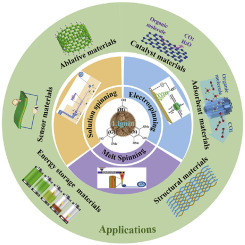
As an aromatic polymer in nature, lignin has recently attracted gross attention because of its advantages of high carbon content, low cost and bio-renewability. However, most lignin is directly burnt for power generation to satisfy the energy demand of the pulp mills. As a result, only a handful of isolated lignin is used as a raw material. Thus, increasing value addition on lignin to expand its scope of applications is currently a challenge demanding immediate attention. Many efforts have been made in the valorization of lignin, including the preparation of precursors for carbon fibers. However, its complex structure and diversity significantly restrict the spinnability of lignin. In this review, we provide elaborate knowledge on the preparation of lignin-based carbon fibers ranging from the relationships among chemical structures, formation conditions and properties of fibers, to their potential applications. Specifically, control procedures for different spinning methods of lignin, including melt spinning, solution spinning and electrospinning, together with stabilization and carbonization are deeply discussed to provide an overall understanding towards the formation of lignin-based carbon fibers. We also offer perspectives on the challenges and new directions for future development of lignin-based carbon fibers.
As an aromatic polymer in nature, lignin has recently attracted gross attention because of its advantages of high carbon content, low cost and bio-renewability. However, most lignin is directly burnt for power generation to satisfy the energy demand of the pulp mills. As a result, only a handful of isolated lignin is used as a raw material. Thus, increasing value addition on lignin to expand its scope of applications is currently a challenge demanding immediate attention. Many efforts have been made in the valorization of lignin, including the preparation of precursors for carbon fibers. However, its complex structure and diversity significantly restrict the spinnability of lignin. In this review, we provide elaborate knowledge on the preparation of lignin-based carbon fibers ranging from the relationships among chemical structures, formation conditions and properties of fibers, to their potential applications. Specifically, control procedures for different spinning methods of lignin, including melt spinning, solution spinning and electrospinning, together with stabilization and carbonization are deeply discussed to provide an overall understanding towards the formation of lignin-based carbon fibers. We also offer perspectives on the challenges and new directions for future development of lignin-based carbon fibers.
2024, 9(9): 1366-1383.
doi: 10.1016/j.gee.2023.10.002
Abstract:
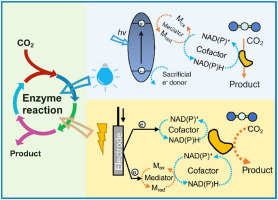
The increasing atmospheric carbon dioxide (CO2) concentration has exposed a series of crises in the earth's ecological environment. How to effectively fix and convert carbon dioxide into products with added value has attracted the attention of many researchers. Cell-free enzyme catalytic system coupled with electrical and light have been a promising attempt in the field of biological carbon fixation in recent years. In this review, the research progresses of photoenzyme catalysis, electroenzyme catalysis and photo-electroenzyme catalysis for converting carbon dioxide into chemical products in cell-free systems are systematically summarized. We focus on reviewing and comparing various coupling methods and principles of photoenzyme catalysis and electroenzyme catalysis in cell-free systems, especially the materials used in the construction of the coupling system, and analyze and point out the characteristics and possible problems of different coupling methods. Finally, we discuss the major challenges and prospects of coupling physical signals and cell-free enzymatic catalytic systems in the field of CO2 fixation, suggesting possible strategies to improve the carbon sequestration capacity of such systems.
The increasing atmospheric carbon dioxide (CO2) concentration has exposed a series of crises in the earth's ecological environment. How to effectively fix and convert carbon dioxide into products with added value has attracted the attention of many researchers. Cell-free enzyme catalytic system coupled with electrical and light have been a promising attempt in the field of biological carbon fixation in recent years. In this review, the research progresses of photoenzyme catalysis, electroenzyme catalysis and photo-electroenzyme catalysis for converting carbon dioxide into chemical products in cell-free systems are systematically summarized. We focus on reviewing and comparing various coupling methods and principles of photoenzyme catalysis and electroenzyme catalysis in cell-free systems, especially the materials used in the construction of the coupling system, and analyze and point out the characteristics and possible problems of different coupling methods. Finally, we discuss the major challenges and prospects of coupling physical signals and cell-free enzymatic catalytic systems in the field of CO2 fixation, suggesting possible strategies to improve the carbon sequestration capacity of such systems.
2017, 2(3): 246-277.
doi: 10.1016/j.gee.2017.06.006
Abstract:
The aluminum–air battery is considered to be an attractive candidate as a power source for electric vehicles (EVs) because of its high theoretical energy density (8100 Wh kg−1), which is significantly greater than that of the state-of-the-art lithium-ion batteries (LIBs). However, some technical and scientific problems preventing the large-scale development of Al–air batteries have not yet to be resolved. In this review, we present the fundamentals, challenges and the recent advances in Al–air battery technology from aluminum anode, air cathode and electrocatalysts to electrolytes and inhibitors. Firstly, the alloying of aluminum with transition metal elements is reviewed and shown to reduce the self-corrosion of Al and improve battery performance. Additionally for the cathode, extensive studies of electrocatalytic materials for oxygen reduction/evolution including Pt and Pt alloys, nonprecious metal catalysts, and carbonaceous materials at the air cathode are highlighted. Moreover, for the electrolyte, the application of aqueous and nonaqueous electrolytes in Al–air batteries are discussed. Meanwhile, the addition of inhibitors to the electrolyte to enhance electrochemical performance is also explored. Finally, the challenges and future research directions are proposed for the further development of Al–air batteries.
The aluminum–air battery is considered to be an attractive candidate as a power source for electric vehicles (EVs) because of its high theoretical energy density (8100 Wh kg−1), which is significantly greater than that of the state-of-the-art lithium-ion batteries (LIBs). However, some technical and scientific problems preventing the large-scale development of Al–air batteries have not yet to be resolved. In this review, we present the fundamentals, challenges and the recent advances in Al–air battery technology from aluminum anode, air cathode and electrocatalysts to electrolytes and inhibitors. Firstly, the alloying of aluminum with transition metal elements is reviewed and shown to reduce the self-corrosion of Al and improve battery performance. Additionally for the cathode, extensive studies of electrocatalytic materials for oxygen reduction/evolution including Pt and Pt alloys, nonprecious metal catalysts, and carbonaceous materials at the air cathode are highlighted. Moreover, for the electrolyte, the application of aqueous and nonaqueous electrolytes in Al–air batteries are discussed. Meanwhile, the addition of inhibitors to the electrolyte to enhance electrochemical performance is also explored. Finally, the challenges and future research directions are proposed for the further development of Al–air batteries.
2017, 2(1): 51-57.
doi: 10.1016/j.gee.2017.01.002
Abstract:
In this work, with the purpose to explore the coordination chemistry of calcium complexes which could work as a partial model of manganese–calcium cluster, a spectrophotometric study to evaluate the stability of the complexes: Calcium(II)-1,2-ethylendiamine, Calcium(II)-1,3-propanediamine and Calcium(II)-1,4-butanediamine in acetonitrile, were carried on. By processing the spectrophotometric data with the HypSpec program allows the determination of the formation constants. The logarithmic values of the formation constants obtained for Calcium(II)-1,2-ethylendiamine, Calcium(II)-1,3-propanediamine and Calcium(II)-1,4-butanediamine were log β110 = 4.69, log β110 = 5.25 and log β110 = 4.072, respectively.
In this work, with the purpose to explore the coordination chemistry of calcium complexes which could work as a partial model of manganese–calcium cluster, a spectrophotometric study to evaluate the stability of the complexes: Calcium(II)-1,2-ethylendiamine, Calcium(II)-1,3-propanediamine and Calcium(II)-1,4-butanediamine in acetonitrile, were carried on. By processing the spectrophotometric data with the HypSpec program allows the determination of the formation constants. The logarithmic values of the formation constants obtained for Calcium(II)-1,2-ethylendiamine, Calcium(II)-1,3-propanediamine and Calcium(II)-1,4-butanediamine were log β110 = 4.69, log β110 = 5.25 and log β110 = 4.072, respectively.
2024, 9(9): 1459-1465.
doi: 10.1016/j.gee.2023.09.002
Abstract:
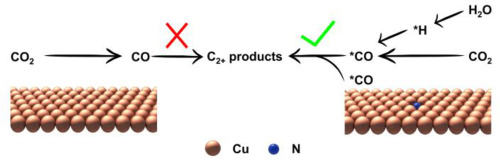
To improve the electrocatalytic transformation of carbon dioxide (CO2) to multi-carbon (C2+) products is of great importance. Here we developed a nitrogen-doped Cu catalyst, by which the maximum C2+ Faradaic efficiency can reach 72.7% in flow-cell system, with the partial current density reaching 0.62 A cm-2. The in situ Raman spectra demonstrate that the *CO adsorption can be strengthened on such a N-doped Cu catalyst, thus promoting the *CO utilization in the subsequent C-C coupling step. Simultaneously, the water activation can be well enhanced by N doping on Cu catalyst. Owing to the synergistic effects, the selectivity and activity for C2+ products over the N-deoped Cu catalyst are much improved.
To improve the electrocatalytic transformation of carbon dioxide (CO2) to multi-carbon (C2+) products is of great importance. Here we developed a nitrogen-doped Cu catalyst, by which the maximum C2+ Faradaic efficiency can reach 72.7% in flow-cell system, with the partial current density reaching 0.62 A cm-2. The in situ Raman spectra demonstrate that the *CO adsorption can be strengthened on such a N-doped Cu catalyst, thus promoting the *CO utilization in the subsequent C-C coupling step. Simultaneously, the water activation can be well enhanced by N doping on Cu catalyst. Owing to the synergistic effects, the selectivity and activity for C2+ products over the N-deoped Cu catalyst are much improved.
2023, 8(2): 351-353.
doi: 10.1016/j.gee.2022.06.002
Abstract:
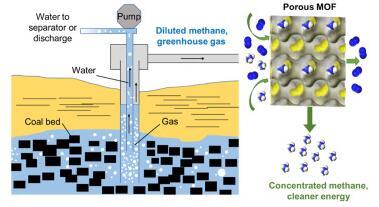
Under the context of carbon neutrality of China, it is urgent to shift our energy supply towards cleaner fuels as well as to reduce the greenhouse gas emission. Currently, coal is the main fossil fuel energy source of China. The country is striving hard to replace it with methane, a cleaner fossil fuel. Although China has rich geological resources of methane as coal bed methane (CBM) reserves, it is quite challenging to utilize them due to low concentration. The CBM is however mainly emitted directly to atmosphere during coal mining, causing waste of the resource and huge contribution to greenhouse effect. The recent work by Yang et al. demonstrated a potential solution to extract low concentration methane selectively from CBM through using MOF materials as sorbents. Such kind of materials and associated separation technology are promising to reduce greenhouse gas emission and promote the methane production capability, which would contribute to carbon neutrality in dual pathways.
Under the context of carbon neutrality of China, it is urgent to shift our energy supply towards cleaner fuels as well as to reduce the greenhouse gas emission. Currently, coal is the main fossil fuel energy source of China. The country is striving hard to replace it with methane, a cleaner fossil fuel. Although China has rich geological resources of methane as coal bed methane (CBM) reserves, it is quite challenging to utilize them due to low concentration. The CBM is however mainly emitted directly to atmosphere during coal mining, causing waste of the resource and huge contribution to greenhouse effect. The recent work by Yang et al. demonstrated a potential solution to extract low concentration methane selectively from CBM through using MOF materials as sorbents. Such kind of materials and associated separation technology are promising to reduce greenhouse gas emission and promote the methane production capability, which would contribute to carbon neutrality in dual pathways.
Editor-in-Chief:Buxing Han
News
- Latest impact facor 8.207 23 July 2021
- Etching Process Enhances the Extraction of Hydrogen during Water Electrolysis 06 July 2021
- Green Energy & Environment 2019 Impact Factor Released: 6.395 06 July 2021


This journal is a member of and subscribes to the principles of the Committee on Publication Ethics.


 京公网安备 11010802039050号